I get why electricity bills keep climbing every single summer, and solar has gone from "that thing rich people do" to something your neighbor's uncle actually installed last month. But the pricing info out there is a mess. Half the sites quote panel-only prices, half quote full-system prices, and almost nobody breaks down what the subsidy actually knocks off.
So here's the truth, laid out plainly. No fluff, no inflated numbers to scare you into buying more than you need.
What Does Solar Panel Cost in India Look Like in 2026?
For a complete, installed, on-grid residential system panels, inverter, mounting structure, wiring, the total cost usually comes to around.
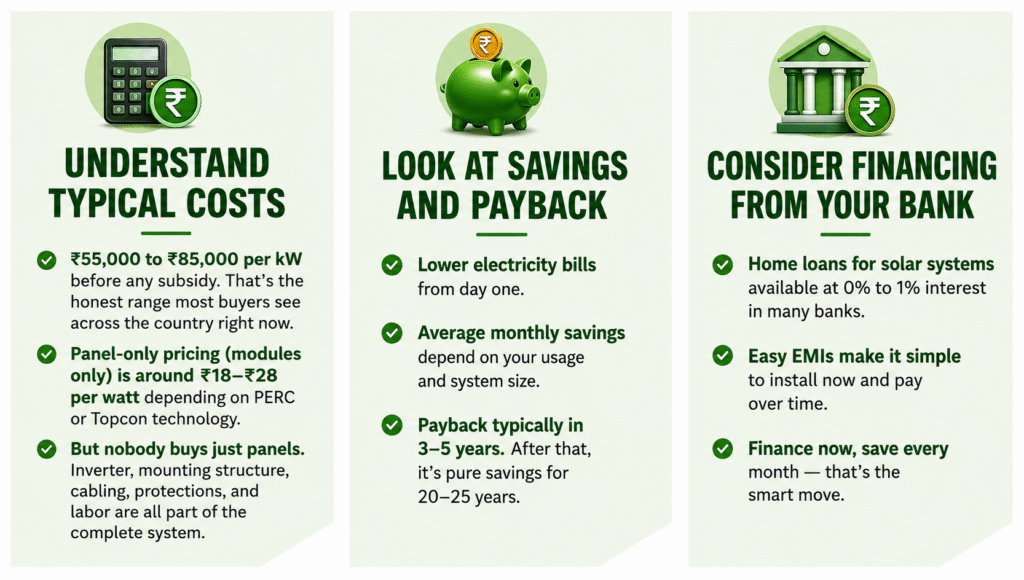
So when someone throwsaround a number like "₹40,000 per kW," ask them what's missing. Usually it's the earthing, the DB integration, or proper AC/DC protection. Cutting those corners to hit a lower headline price is exactly the kind of shortcut that costs you double later.
Solar Panel Price by System Size (Before Subsidy)
Let's break it down by the sizes most Indian homes actually go for.
1 kW system around ₹70,000 to ₹1.1 lakh. Good for a small flat running lights, fans, a fridge, maybe a TV. Not much beyond that, honestly.
2 kW system roughly ₹1.1 lakh to ₹1.6 lakh. Covers a small home with moderate daytime usage.
3 kW system: This is the sweet spot for most 2–3 BHK homes Solar Panel Installation in India for a 3 kW system usually costs ₹1.65 lakh to ₹2.35 lakh before subsidy. Most families opt for this size because it qualifies for the maximum central subsidy while covering 300–450 units of monthly electricity usage.
5 kW system: for bigger households or homes running 2 ACs plus an EV charger down the line. Budget ₹2.75 lakh to ₹3.75 lakh.
10 kW system: this is really a small rooftop plant at this point, not a "kit." String planning, distribution board work, monitoring — it all adds complexity. Expect ₹5.5 lakh to ₹8.5 lakh, and prices swing a lot here based on quality.
These numbers move around by 5-15% depending on your city too. Rajasthan, Gujarat and Maharashtra tend to run a bit cheaper because of higher solar activity and more competition among installers. Delhi and the North generally see slightly higher labor costs.
The Subsidy Breakdown: PM Surya Ghar Muft Bijli Yojana
Okay, here's the part everyone actually cares about how much does the government actually give you back?
The scheme is called PM Surya Ghar Muft Bijli Yojana, and as of 2026 it's still very much alive and funded through FY 2026-27. Over 40 lakh households have already claimed it, so this isn't some pilot program that might fizzle out. It's real, it's working, and the money does land in your account.
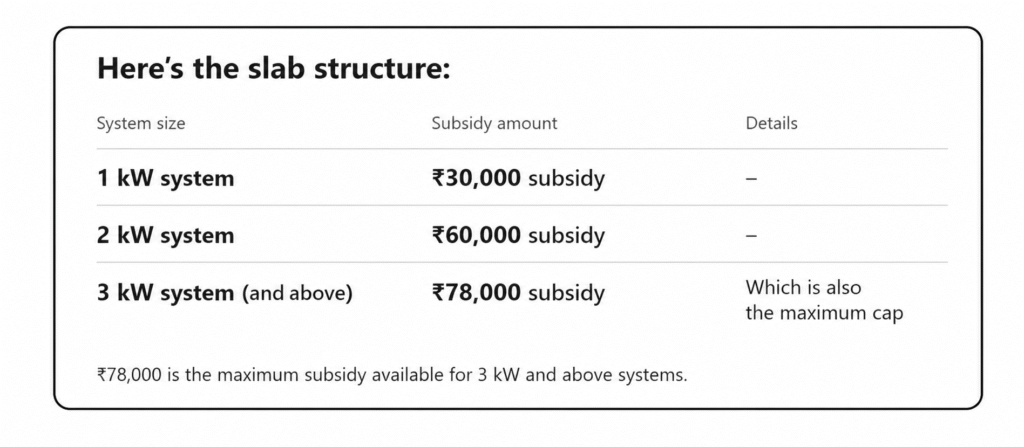
That last point trips a lot of people up. Install a 5 kW or even a 10 kW system, and you still only get ₹78,000. The subsidy doesn't scale up with size past 3 kW anything above that, you're paying the full market rate yourself. Solar installers who tell you otherwise are either misinformed or being sneaky about it.
One more thing worth knowing: the subsidy is calculated against MNRE's benchmark cost, not whatever number your installer quotes you. So if your quote is way above the benchmark for your system size, you still only get the benchmark-based subsidy. Don't assume a fancier quote automatically means a fatter subsidy it doesn't work that way.
The money itself comes as a Direct Benefit Transfer straight into your Aadhaar-linked bank account, usually within 30-45 days after your DISCOM does the inspection and commissioning. No middlemen, no cash handling.
What You Actually Pay (After Subsidy)
Putting the two numbers together, here's what a real household ends up paying, out of pocket, for the most common system sizes.
A 1 kW system running ₹70,000-1.1 lakh, minus the ₹30,000 subsidy, lands you around ₹40,000-80,000 net.
A 3 kW system the one most families choose running roughly ₹1.65-2.35 lakh, minus the ₹78,000 subsidy, comes out to about ₹87,000-1.57 lakh net. That's a meaningful chunk off, and for most North Indian and South Indian cities that translates to a payback period of somewhere between 3 and 6 years. After that, you're basically running your home on free electricity for the next 20+ years.
Truth is, these numbers make solar one of the few home upgrades left in India where the math genuinely works in your favor, subsidy or not.
Why Cutting Corners on Solar Quality Is a Mistake
Look, I get the temptation. Someone quotes you 15% cheaper and it's tempting to just go with them. But solar isn't a one-time purchase you forget about it's a 20-25 year investment sitting on your roof, exposed to Indian summers, monsoons, and dust every single day.
Cheap panels degrade faster. Cheap inverters fail within 3-4 years instead of lasting 10. Skipped earthing or missing AC/DC protections aren't things you notice on day one they show up as safety hazards or fried components two monsoons down the line. And here's the part nobody tells you: non-ALMM listed panels (that's the government's approved manufacturers list) can straight up disqualify you from the subsidy. You'd lose ₹60,000-78,000 because someone cut a corner on sourcing.
This is exactly where a company's track record matters more than its lowest quote. At JSM Solar Power, the panels and inverters that go up are ALMM-compliant, BIS certified, and the installation follows proper protocols earthing, protections, the works because a solar system that fails at year 5 defeats the entire point of going solar in the first place. Quality solar power energy isn't a luxury add-on. It's the actual product you're paying for.
Factors That Actually Move Your Solar Panel Price
A few things swing your final number more than people expect.
Panel technology matters PERC is the standard workhorse now, Topcon costs a bit more but squeezes out better efficiency, and HJT is the premium end most homeowners don't need unless roof space is really tight.
Your roof condition plays a bigger role than most quotes account for. RCC roofs are straightforward. Metal sheet roofs, older structures, or roofs needing reinforcement can add cost that a lowball quote conveniently leaves out.
Inverter grade is another quiet cost driver string inverters are standard for residential, hybrid inverters (which let you add battery backup later) cost more upfront but give you flexibility.
And honestly, your installer's experience with DISCOM paperwork matters too. A vendor who's done this a hundred times gets your net metering approved in weeks. An inexperienced one can leave you waiting months, subsidy delayed the whole time.
Is 2026 a Good Time to Go Solar in India?
Short answer -Yes, and here's why I'd say don't wait around for it to get "even better."
Solar panel prices have been trending down for years as manufacturing scales up domestically. At the same time, the subsidy program is stable, well-funded, and processing applications faster than it did at launch back in 2024. You've got the rare combination of falling equipment costs and active government support running at the same time. That window doesn't stay open forever subsidy programs get revised, tightened, or capped as budgets shift.
Add rising DISCOM tariffs into the mix (electricity bills aren't going down, let's not pretend), and the payback math only gets better the longer grid electricity stays expensive.
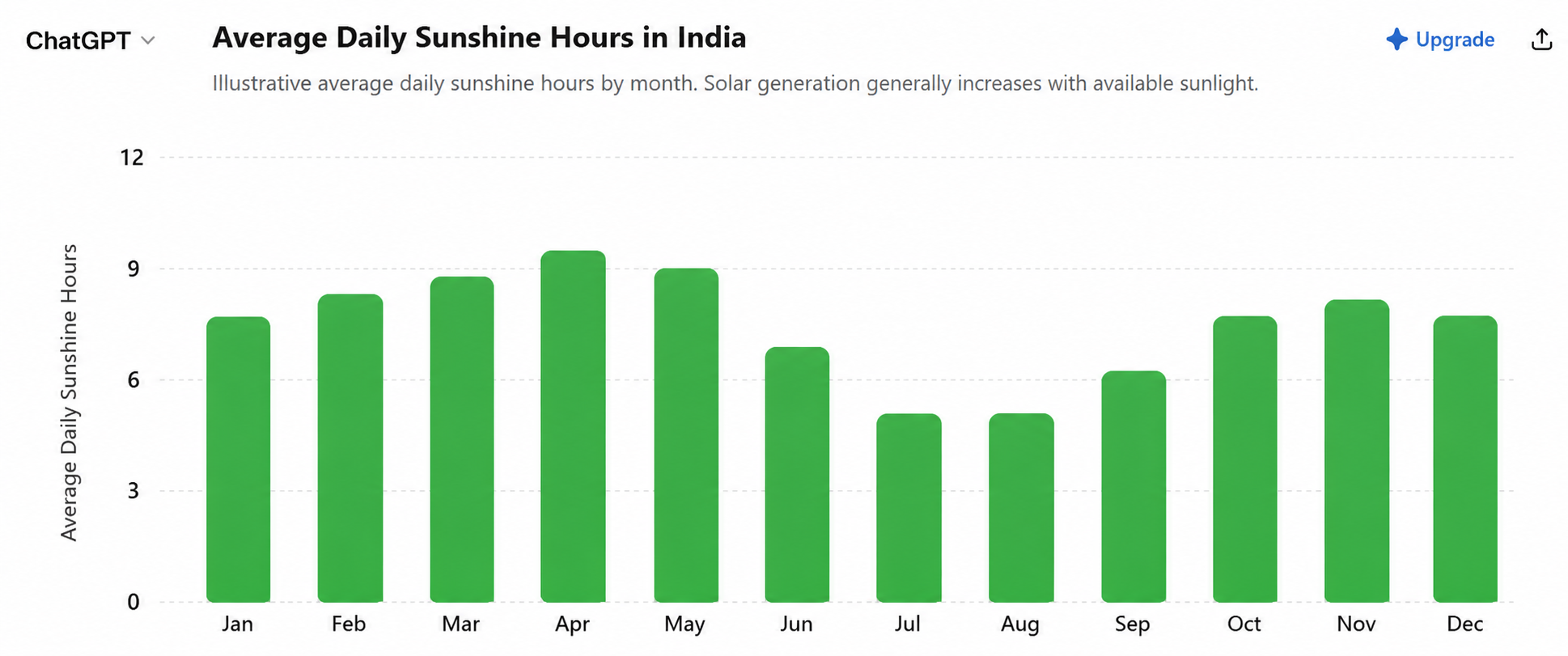
Solar generation closely follows the amount of sunlight your location receives. Here's how average monthly sunshine hours vary across India throughout the year.
Final Word
The solar panel cost in India in 2026 isn't one fixed number it depends on your system size, your city, your roof, and honestly, who you choose to install it. But the range is predictable enough now that you can budget for it like any other home upgrade. ₹55,000-85,000 per kW before subsidy, up to ₹78,000 back from the government, and a payback window most families hit within 3-6 years.
The real decision isn't whether solar makes financial sense in 2026 it clearly does. It's choosing an installer who won't cut corners on the equipment or the paperwork, because that's what determines whether your system is still performing at full output in year 15, not just year one.
Visit JSM Solar Power to start your build to get a proper site assessment, transparent pricing with the subsidy already worked into the numbers, and a system built to actually last the 25 years you're paying for.
FAQs
What do solar panels cost for a home in India these days?
Somewhere between ₹55,000 and ₹85,000 per kW, fully installed, before any subsidy. Most folks go with a 3 kW system, and those lands around ₹1.65-2.35 lakh, subsidy not counted yet.
How much subsidy is on the table with PM Surya Ghar?
1 kW = ₹30,000. 2 kW = ₹60,000. 3 kW and up = ₹78,000, and that's it, that's the max. Doesn't matter if you install a 5 kW or a 10 kW system, subsidy stays capped at ₹78k.
After subsidy, what's a 3kW system really cost me?
Netting out to roughly ₹87,000-1.57 lakh. Depends where you live and which brand of panels/inverter you go with.
Is this subsidy thing still around in 2026 or did it end?
Still going strong, funded through FY 2026-27. Apply anytime at pmsuryaghar.gov.in.
How long till solar pays for itself?
3 to 6 years, give or take. Then you're pulling free power for 20-plus years after that.
Does location change the price much?
Some, Yes 5-15% either way. Rajasthan, Gujarat, that belt tends to be cheaper thanks to more competition among installers. Big metros with pricier labor push costs up a bit.
Categories: Blog1